A Full Arch on Fewer Implants, Even With Lower Bone Density
Most people who’ve been told they don’t have enough bone for dental implants heard that from someone evaluating a traditional, straight implant placement. All-on-X was built around a different premise entirely: that a full arch could be supported with fewer implants, placed at angles that work with the bone you already have, rather than the bone a conventional approach would require.
Dr. Heimke has taught the All-on-X technique to dentists nationally and internationally for nearly 20 years. That depth of experience matters here specifically, since the angled placement that makes All-on-X possible with lower bone density also leaves very little margin for error.
Wondering if your bone density qualifies you for All-on-X? Call our Cleveland Smile Studio at (888) 255-3588 to schedule your complimentary consultation.
Why Choose Dr. Heimke for Full-Arch Restoration
Full-arch implant work is one of the most technically demanding procedures in dentistry, and it shows in how it’s usually delivered: rushed timelines, generic bridges, and a result that looks like a denture instead of a smile. FAD’s approach is built differently from the start.
Every All-on-X case begins with Ray Face 3D AI facial scanning, a Medit i900 intraoral scan, and a 3D CBCT scan, giving Dr. Heimke and your Implant Surgeon a precise map of your bone before a single implant is placed. Same-day delivery is handled through Photogrammetry technology, which captures the exact position of each implant in real time so your temporary bridge, known as the Healing Hybrid, fits with a level of accuracy that traditional impression methods can’t match.
FAD’s Partner Dental Lab
Your final bridge is a Prettau zirconia hybrid, crafted through the Oral Design Atlanta laboratory under Pinhas Adar, one of the most respected ceramists in the country. That’s a different caliber of craftsmanship than a standard acrylic hybrid denture, and it shows in both the way the arch reflects light and how it holds up over time. For clients traveling from outside Northeast Ohio, our Guest Concierge coordinates your visit around the full-arch timeline so multiple appointments never mean multiple headaches.
What Actually Makes All-on-X Different
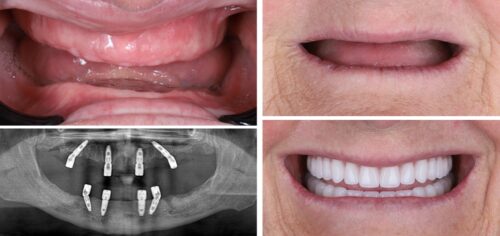 In a conventional implant placement, each implant is positioned straight up and down, which requires a certain height and density of bone at each site. When that bone isn’t there, particularly toward the back of the upper or lower jaw, the standard fix has historically been a bone graft or sinus lift before implants could be placed at all.
All-on-4 (and similar All-on-X procedures) sidesteps that requirement through implant angle. Two implants are placed upright toward the front of the arch, where bone is typically most available. The remaining two are placed at an angle toward the back, tilted to engage the denser bone found along the sides of the jaw rather than relying on the vertical height that’s often lacking there. This baseline four-implant pattern can be expanded to five or six.
All-on-X Compared to Other Full-Arch Options
- Against Implant-Supported Dentures, All-on-X is fixed rather than removable, meaning it doesn’t come out at night and doesn’t rely on suction or clips to stay in place.
- Compared to a traditional denture, All-on-X stops the bone loss that comes from an arch with no root stimulation at all, which a denture resting on the gums cannot do.
Do You Qualify for All-on-X Without a Bone Graft?
This is the question most people actually want answered, and it depends on where your bone loss is, not just how much bone you’ve lost overall.
You’re likely to qualify without grafting if:
- Your CBCT scan shows adequate bone along the front of the arch, where the straight implants go
- There’s sufficient bone density along the sides of the jaw, where the angled implants will engage
- Your overall arch width and bite alignment are compatible with a four, five, or six-implant support pattern
You may still need a bone graft or sinus lift if:
- Bone loss extends into the front of the arch as well, leaving no stable site for the straight implants
- You’re missing enough bone height in the upper jaw specifically that even an angled implant can’t find adequate purchase, which is more common in the upper arch than the lower
- Long-term denture wear has caused more extensive bone resorption than the angled technique can accommodate
The only way to know which category you fall into is a CBCT scan. Many clients who assumed grafting was inevitable find out at consultation that All-on-X’s angled design already solves the problem their prior evaluation didn’t account for.
When All-on-4 Isn’t Enough: All-on-5 and All-on-6
Four implants is the minimum needed to support a full arch, not the maximum available. Dr. Heimke will typically recommend All-on-5 or All-on-6 instead of All-on-4 when:
- Bite force is a concern. Clients with a strong bite, or a history of grinding, distribute that force across more implants with a five- or six-implant pattern, reducing strain on any single implant over decades of use.
- The arch is wider than average. A wider arch means a longer bridge span, and additional implants provide support at more points along that span.
- Bone quality allows for it, but isn’t ideal for load-bearing on just four. In some cases, the bone is adequate for four implants but not dense enough to comfortably support the bite force long-term, making the added implants a durability decision rather than a bone-availability one.
- You want built-in redundancy. If one implant in a six-implant arch were ever to fail, the remaining five can typically continue supporting the bridge while it’s addressed. That safety margin doesn’t exist the same way with exactly four.
This is a planning decision made at your CBCT evaluation, not something you choose independently. Dr. Heimke will tell you specifically why he’s recommending one over the other for your bone and bite.
The Same-Day Placement Process
Unlike a single implant, which typically heals beneath the gum before a crown is attached, All-on-X delivers a functioning temporary bridge the same day implants are placed.
- Extraction, If Needed: Any remaining failing teeth are removed at the same visit, so there’s no separate extraction appointment before treatment begins.
- Implant Placement: Your Implant Surgeon places the implants using the angled protocol, positioning them to work with your existing bone density.
- Digital Positioning Capture: Photogrammetry technology records the exact three-dimensional position of each implant in real time as they’re placed.
- Healing Bridge Fabrication: That positioning data is used to 3D-print your temporary bridge, “The Smile,” which is secured to the implants before you leave. You’re never without a functioning arch during the eight to 12 weeks it takes for the implants to fuse with the jawbone.
- Final Bridge Placement: Once healing is complete, the Healing Hybrid is replaced with your final Prettau zirconia hybrid bridge, crafted through the Oral Design Atlanta laboratory under Pinhas Adar and fitted to your finished bite.
Are You a Candidate for All-on-X?
You’re likely a candidate if you’re missing most or all of the teeth in one arch and your CBCT scan shows adequate bone along the front of the jaw and sufficient density at the angled implant sites toward the back. Clients currently wearing an unstable denture, dealing with widespread failing dental work, or managing advanced gum disease across an arch are frequently good candidates, specifically because the angled technique is designed for situations where bone has already been compromised.
Investment in Your Smile: All-on-X Costs and Financing
All-on-X costs more than a single implant or a partial bridge, reflecting the surgical planning, the temporary Healing Hybrid, and the final Prettau zirconia bridge involved in a full-arch case. Costs can shift based on whether a bone graft turns out to be needed despite the angled placement, and whether your case calls for four implants or is upgraded to five or six at consultation. We’ll walk through your specific cost estimate before any treatment begins, and work with Cherry Financing to help build a plan that fits your timeline.
Frequently Asked Questions
Bone density and height often taper off toward the back of the jaw before they taper off toward the front. Angling the rear implants lets them reach denser bone along the side of the jaw instead of relying on the vertical bone height a straight implant would need in that same spot.
This is one of the trade-offs of a four-implant design compared to five or six. If an implant fails, your Implant Surgeon will evaluate whether it can be replaced while the bridge remains supported by the others, or whether the bridge needs temporary adjustment during that process.
It’s a fixed restoration, secured to the implants and not designed for daily removal. This is different from implant-supported dentures, which are removable by design.
Four individual implants would each support their own single tooth. All-on-4 uses four implants to support one continuous bridge replacing an entire arch, which requires far fewer implants than replacing each tooth individually.
Start Your All-on-X Journey in Rocky River or Sandusky
A full arch of failing teeth doesn’t require a full arch of implants to fix it. With an angled placement technique built for lower bone density and nearly 20 years of teaching this exact protocol, Dr. Heimke can tell you at consultation whether All-on-4, All-on-5, or All-on-6 is the right fit for your case.
Call The Facial Aesthetic Designers at (888) 255-3588 to schedule your complimentary consultation and discover our full-arch implant solutions in Rocky River, OH.